The “People Will Have to Die” Fallacy
Brian Lehrer, the host of a daily NPR show bearing his name, broke my heart today. “It could be, sadly, that it’s going to be a lot of death and disease that ends this period,” he said in a panel at the New York Academy of Medicine on the topic of “how media shapes population health outcomes.”
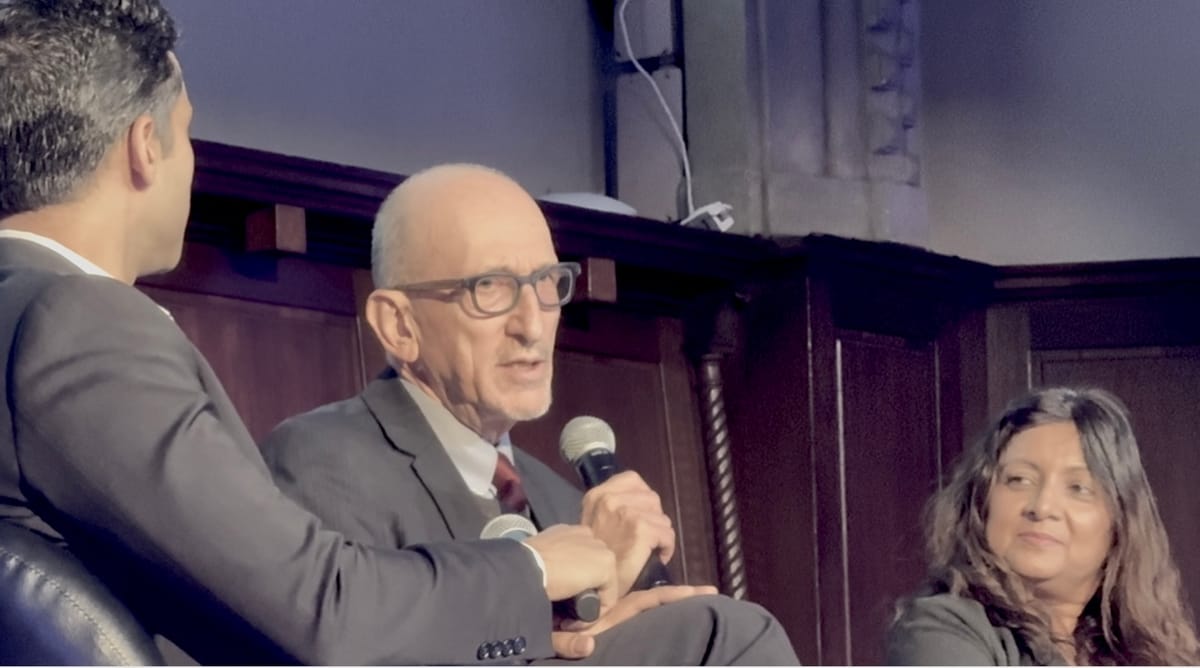
Brian Lehrer, my beloved host of a daily NPR show bearing his name, broke my heart today.
“It could be, sadly, that it’s going to be a lot of death and disease that ends this period,” he said in a panel at the New York Academy of Medicine on the topic of “how media shapes population health outcomes.”
Others on the panel - Dhruv Khullar (The New Yorker) and Apoorva Mandavilli (The New York Times) - agreed, or at least did not object.
Here is how this argument goes: “We don’t know how else to explain to the anti-vaxxers that they are wrong. Only when people start dying will they realize that they made a mistake.”
Here is Paul Offit’s version: "I used to say that the tide would turn when children started to die. Well, children have started to die. So now I've changed it to 'when enough children start to die.' Because obviously, we're not there yet.”
He said this in 2009.
Here is why I find this logic appalling.
First, it is deeply disrespectful to the 16% of parents in the US who are declining or delaying some vaccines (more if you consider COVID and Flu shots). Their main concern is safety, as a recent KFF/Washington Post poll showed. Let’s get them that safety data. We said in 2019 that we needed to generate more vaccine safety data, but then COVID happened and we never got around to it.
Worse, we never formally assessed why the parents are worried about vaccine safety. What do they want to know? What are their questions, or “information needs?”
Shockingly, this has never been studied, until we took this on at Eviva Partners. (In contrast, there is a huge body of literature on the information needs of cancer patients, for example).
Why? Perhaps because vaccine-hesitant people are considered to be "wrong," like flat-earthers, for example. You wouldn't study information needs of flat-earthers (however, see this). In addition, as one expert told me, “The CDC did not want to worry people by legitimizing vaccine-related questions, so that line of communication was not allowed. Professional societies like the American Academy of Pediatrics followed suit.“
Then, we have local communities, such as the West Texas Mennonites. They have another problem, as I learned on my trips there: they don't learn practically any science in their religious schools, similar to Hassidic schools in New York (West Texas Mennonites are much more conservative than the main Mennonite community, akin to Hassidic Jews vs mainstream Jews.). No wonder they cannot see the value in vaccines and are easy prey to bad actors like Childrens Health Defense. Let's teach them science. "Mennonites are our main customers," the director of the Seminole public library told me. And they loved the science books I brought.
Or how about African-American mothers in our focus groups who asked, "was this vaccine studied in people like me?" Not well, is the answer. Let's do some real-world data analyses and close this gap.
Second, suppose, despite all of these things we could do, we adopt the “people will have to die" strategy, however morally outrageous. We still have the other problem - there is no evidence that it will work. A recent study showed that a measles outbreak in a particular community did not lead to appreciably increased vaccination rates. And we are not even considering that the administration may conceal the true extent of the outbreaks - they have already done this.
Third, vaccination gaps are to a large extent due to lack of access, as experts such as Julie Leask and Katie Attwell point out. "US states are heavily reliant on vaccine mandates because of the country’s under-resourced and privatised health system, which can make it difficult for some families to access vaccines," they recently wrote. Add that to our to-do list.
So there is so much we could do! Why the doom and gloom? Why continue to blame the public? Because it is a very convenient position of our medical establishment. For example, Peter Hotez and Michael Mann, in their book Science Under Siege, admit no responsibility of Science itself for what happened. It’s all someone else’s fault - Plutocrats, Petrostates, The Pros (professional disinformers), Propagandists, and the Press. Might as well add another “P” - the Public.
Finally, a general comment. We should leave the questions of public communication to the experts. By "experts" I mean people who published at least one research study on how to communicate with the public. This is a separate branch of science that involves a variety of techniques - focus groups, surveys, evaluation, measurement, etc. We have done shockingly little of this in the vaccine space. Most of our public messages - spoken, written, websites, articles, interviews - are not tested or evaluated by communications experts. Time for them to take the lead and for the rest of us to reserve judgment.